 Another major form of energy is nuclear energy, the energy that is trapped inside each atom. One of the laws of the universe is that matter and energy can't be created nor destroyed, but they can be changed in form. Matter can be changed into energy.
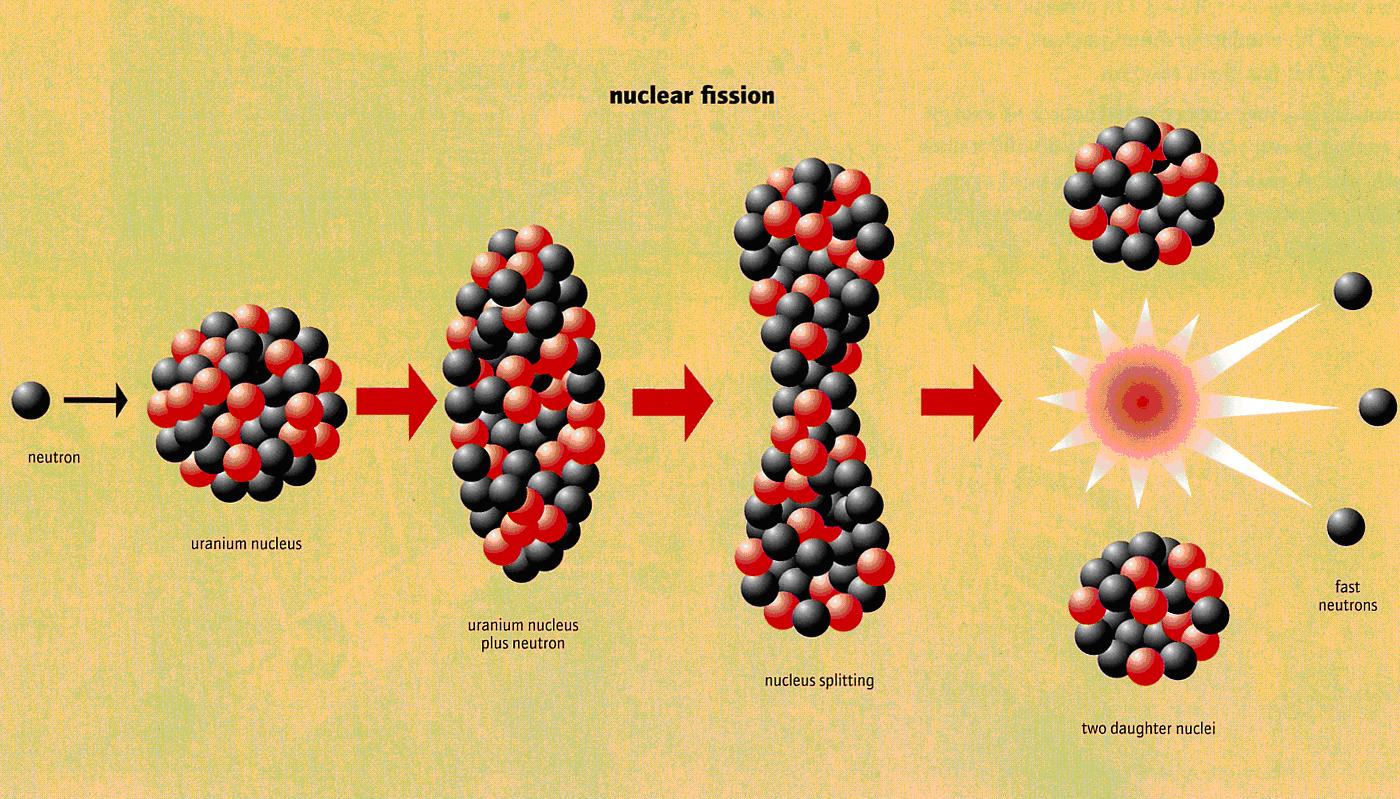
An atom's nucleus can be split apart, this is called fission. When this is done, a tremendous amount of energy is released. Inside the reactor of an atomic power plant, uranium atoms are split apart in a controlled chain reaction. In this chain reaction, particles released by the splitting of the atom go off and strike other uranium atoms splitting those. Those particles given off split still other atoms in a chain reaction. This chain reaction gives off heat energy. Uranium 235 is the fuel most commonly used, because U-235 can be split into fragments using low-energy neutrons. During nuclear fission more energy is produced than consumed. This exothermic reaction then becomes self-sustaining, i.e., a chain reaction. When a neutron is absorbed by nuclear fuel, the nucleus deforms and splits. The products are neutrons and two unequal fragments called “daughter material.” Neutrons released by the splitting of the atom strike other atoms, splitting them in turn, and soon, the daughter material contains too many neutrons and quickly begins to decay. The radioactive daughter material is the source of nuclear waste with water to make steam. This water from around the nuclear core is then sent to another section of the power plant. Here, in the heat exchanger, it heats another set of pipes filled with water to make steam. The steam in this second set of pipes turns a turbine to generate electricity. So, instead of burning a fuel, nuclear power plants use the chain reaction of atoms splitting to change the energy of atoms into heat energy.
Another major form of energy is nuclear energy, the energy that is trapped inside each atom. One of the laws of the universe is that matter and energy can't be created nor destroyed, but they can be changed in form. Matter can be changed into energy.
An atom's nucleus can be split apart, this is called fission. When this is done, a tremendous amount of energy is released. Inside the reactor of an atomic power plant, uranium atoms are split apart in a controlled chain reaction. In this chain reaction, particles released by the splitting of the atom go off and strike other uranium atoms splitting those. Those particles given off split still other atoms in a chain reaction. This chain reaction gives off heat energy. Uranium 235 is the fuel most commonly used, because U-235 can be split into fragments using low-energy neutrons. During nuclear fission more energy is produced than consumed. This exothermic reaction then becomes self-sustaining, i.e., a chain reaction. When a neutron is absorbed by nuclear fuel, the nucleus deforms and splits. The products are neutrons and two unequal fragments called “daughter material.” Neutrons released by the splitting of the atom strike other atoms, splitting them in turn, and soon, the daughter material contains too many neutrons and quickly begins to decay. The radioactive daughter material is the source of nuclear waste with water to make steam. This water from around the nuclear core is then sent to another section of the power plant. Here, in the heat exchanger, it heats another set of pipes filled with water to make steam. The steam in this second set of pipes turns a turbine to generate electricity. So, instead of burning a fuel, nuclear power plants use the chain reaction of atoms splitting to change the energy of atoms into heat energy.