Nylon
In nylon, the repeating units contain chains of carbon atoms. (That is different from Kevlar, where the repeating units contain benzene rings - see below.) There are various different types of nylon depending on the nature of those chains.
Nylon-6,6
Nylon-6,6 is made from two monomers each of which contain 6 carbon atoms - hence its name.
One of the monomers is a 6 carbon acid with a -COOH group at each end - hexanedioic acid.

Note: When you count the carbons don't forget to include the ones in the -COOH groups.
The other monomer is a 6 carbon chain with an amino group, -NH2, at each end. This is 1,6-diaminohexane (also known as hexane-1,6-diamine).

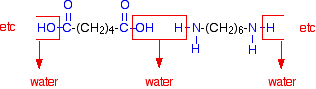
When these two compounds polymerise, the amine and acid groups combine, each time with the loss of a molecule of water. This is known as condensation polymerisation.
Condensation polymerisation is the formation of a polymer involving the loss of a small molecule. In this case, the molecule is water, but in other cases different small molecules might be lost.
The diagram shows the loss of water between two of the monomers:
This keeps on happening, and so you get a chain which looks like this:
